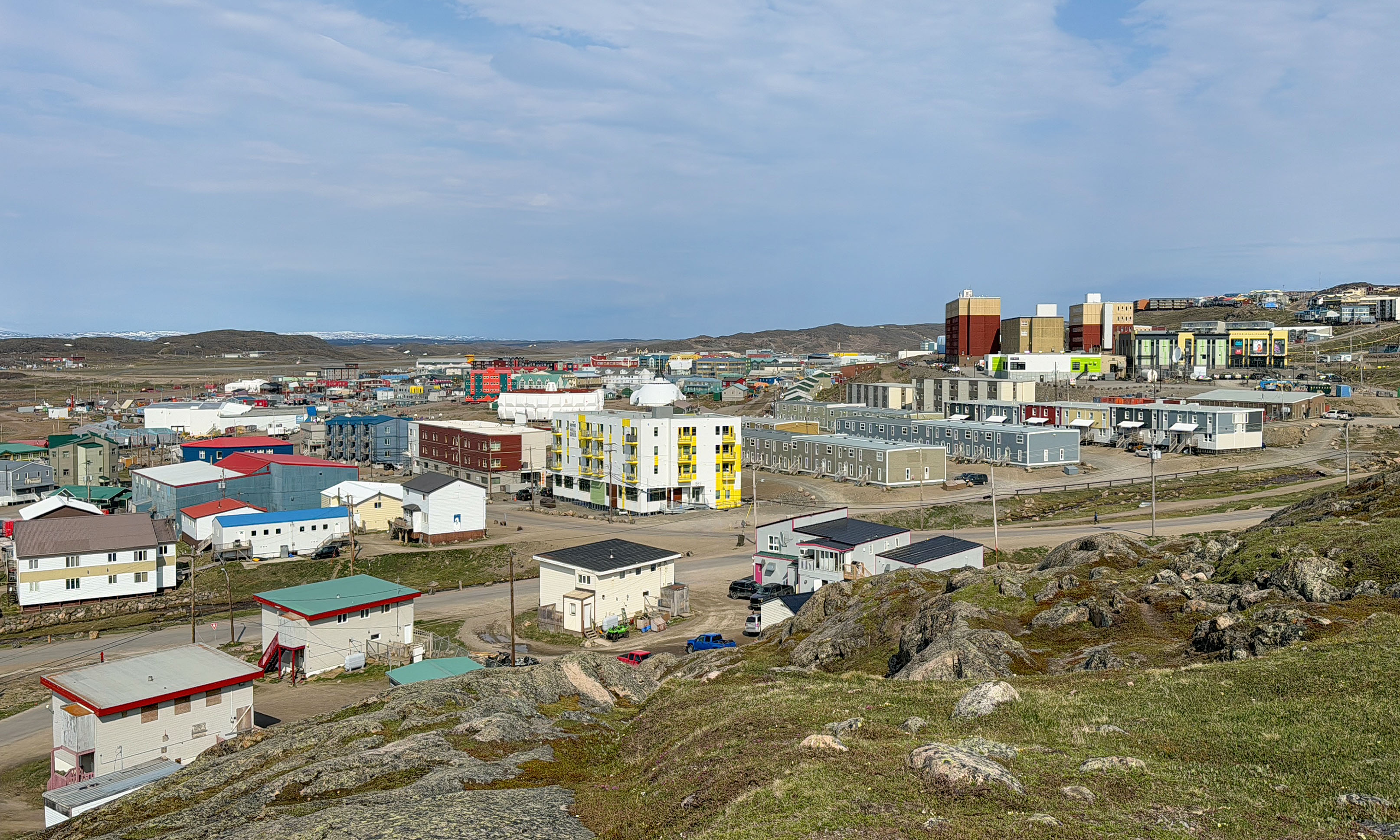
Iqaluit, Nunavut
Wikimedia Commons via Wikipedia

Nunavut · Civic arena

Iqaluit

Iqaluit drinking water hardness is 119 mg/L on OpenStats, plus City Score rankings and local readings.

Civic arena · hometown HUD

Iqaluit

City7,700 pop
50XP
#176

#176 of 343

50% City Score XP

RisingSurface
City Score XP

4/8 pillars on the board

50%#176

Decade trail

Iqaluit packs 4 of eight open-data pillars into its composite standing. Tap a rival below to see how the hometown stacks up head-to-head.

Iqaluit drinking water

Regional estimate from nearest municipal sample

Hardness, pH, and lead from municipal reports on the OpenStats water atlas. This page uses a regional estimate — open the water atlas for method notes.

Hardness
119 mg/L
moderately hard
pH
7.2
Lead
0.7 μg/L

Full Iqaluit water quality report →City Score rankingsCompare cities · vs Smiths Falls · vs TecumsehHardness guide

Watershed to tap · system map

How Iqaluit's water works

Source, treatment, and distribution for Iqaluit from municipal and provincial water records. Open the animated map for the full watershed-to-tap diagram — no nested topic navigation here.

Local numbers for Iqaluit

Permits, tax, internet, radon, hazards, drinking water, and sports rankings where a CHL hometown applies.

How Iqaluit scores

Rising+48

Iqaluit sits at City Score rank #176 with a standing of 50%, from 4 of 8 open-data pillars (tax, construction, connectivity, indoor air, water, seismic hazard, growth, safety). Missing pillars score at median standing so thin coverage cannot inflate the rank. Rising 48 places versus 2022 (#224 → #176).

Published study placements for Iqaluit are charted below when available. Topic atlases carry the underlying municipal readings for the same place.

Against the national corpus, Iqaluit carries a City Score standing of 50% (rank #176 of 343) with 4 of 8 pillars observed. Within Nunavut, Iqaluit ranks #1 of 1 on City Score.

The strongest signal in the current chart is seismic hazard (standing 81%, rank #277 of 343, raw score 0.031). The weakest observed pillar is broadband download (ISED seed tier) (standing 12%, rank #304 of 343).

Drinking-water hardness on the water atlas reads 119 mg/L as CaCO₃ for Iqaluit. Compare that figure to the hardness pillar on the chart and to the national hardness guide on the hub.
#176
Arena rank (of 343)
50%
City Score
4
Pillars observed
Rising+48
vs 2022
#224 → #176

Arena loadout

Topic XP bars

Arena rank #176 of 343

City Score

4/8 pillars · main XP bar

50%#176
Drinking water

Pillar avg · hardness #269

43%
Building permits

No placement

—
Internet

Rank #304

12%
Radon

No placement

—
Hazards

Rank #277

81%
Property tax

No placement

—

Iqaluit pillar standing

Eight equal-weight City Score pillars, 2025 panel year.

TaxPermitsNetRadonWaterHazardsGrowthCrime

Source: OpenStats composite / study editions

City Score standing trend

Standing percentage by panel year (higher is better).

Years: 2016, 2017, 2018, 2019, 2020, 2021, 2022, 2023, 2024, 2025

Source: OpenStats composite timeseries

Achievements

Rising +48Surface water supply

Hometown notes

City profile

Older hometown notes stay on the desk archive (noindex) — this section shows recent highlights only.

Iqaluit in brief

Iqaluit is Nunavut's capital, and the City still talks to Iqalummiut in a northern register. The recreation header lists a blizzard information line beside RCMP and fire numbers, a small tell that weather can rewrite the day. Municipal life runs through places with Inuktitut names in ordinary use: Makkuttukkuvik Youth Centre, Elder's Qammaq, Abe Okpik Hall, and the Iqaluit Aquatic Centre inside the Arctic Winter Games Complex orbit. Leave No Trace notes on the facilities page even talk about being on the land and at trailheads, which is how recreation is framed here. City Hall sits on Mivvik Street. Plateau Subdivision is the planning name you hear when housing and lots are the file.

Warm months bring Summer in the Square, with a chili cook-off and a local market that City news treats as a civic appointment, not a tourist add-on. Explore pages point visitors and residents alike to Sylvia Grinnell Territorial Park for hiking, Unikkaarvik Visitor Centre and Nunatta Sunakkutaangit Museum for culture stops, and boat trips out to Qaummaarvik Park. Alianait! still names the arts-festival Big Top in municipal visitor copy. Boat storage is its own planning conversation on the City news list, because getting on the water is part of how the town works. Qikiqtani General Hospital anchors health headlines when Nunatsiaq covers local partnerships, and housing demand keeps showing up in the same local news weather.

OpenStats has no City Score placement for Iqaluit in the current datapack. The hometown read stays northern and specific: blizzard phones, Iqalummiut recreation buildings, Summer in the Square, and trails that lead toward Sylvia Grinnell rather than a suburban beltway.

Drawn from City of Iqaluit, City of Iqaluit recreation, Explore Iqaluit, Summer in the Square, Nunatsiaq News.

City Score over time

City Score from 2016–2025 across eight open-data pillars. Individual study placements are listed in the panels below.

0%25%50%75%100%2016201720182019202020212022202320242025
OpenStats City Score

Rankings for Iqaluit

Each study below is its own ranking. Where a study has more than one edition for this city, the chart shows standing across those years only.

Safety · OpenStats

Crime severity not placed

Statistics Canada does not publish a police-service Crime Severity Index that OpenStats can match to Iqaluit without copying a province, CMA, or another city. The safety pillar scores at median standing (50%) on City Score, the same rule used for other missing pillars.

Connectivity · OpenStats

OpenStats Broadband Download Speeds

OpenStats

Cities ranked by household-weighted maximum advertised download (Mbps) from ISED National Broadband Data hex ISP rows, with hex-to-city assignment by population-weighted gravity. The headline 2025 score is the dwelling-weighted mean of per-hex technology ceilings (fibre and cable at 1 Gbps, DSL lower). Household-weighted 50/10 availability (%) is stored on atlas rows as avail_5010_pct. Earlier panel years backcast along a national speed curve with city-specific fiber and availability paths.

10 editions · 2016–2025

#304
Latest · 2025 · of 343
Score 96.2

Composite · OpenStats

OpenStats City Score

OpenStats

Dimensional average of OpenStats open-data pillars for each panel year 2016-2025: tax, construction, connectivity, indoor air, water, seismic hazard, population growth, and crime severity. Each series is scored 0-1 within its edition; series in the same pillar are averaged, then all eight pillars are averaged with equal weight. Missing pillars score at median standing (0.5). Crime severity uses StatCan police-service CSI only (Tables 35-10-0026-01 and 35-10-0063-01); cities without a police-service match take median standing on the safety pillar. Growth uses StatCan CSD estimates; construction uses verified municipal building-permit value per resident (population field on each city record, 2021 Census vintage); mill rates and broadband use live rows plus documented year-varying estimates where needed. Radon, water, and PGA may be survey/model vintages carried forward and are flagged when static for more than two years. External commercial livability lists are never inputs.

10 editions · 2016–2025

#176
Latest · 2025 · of 343
Score 0.497

Water · OpenStats

OpenStats Drinking Water Hardness

OpenStats

Communities ranked by municipal drinking-water hardness (mg/L as CaCO₃). Hardness changes slowly; the atlas vintage is carried across panel years and flagged when static for more than two years.

10 editions · 2016–2025

#269
Latest · 2025 · of 343
Score 119

Growth · OpenStats

OpenStats Population Growth

OpenStats

Cities ranked by year-over-year population growth from Statistics Canada annual CSD estimates (Table 17-10-0155-01). Rank 1 is fastest growth. A few places without a clean CSD match use a provincial-path estimate anchored to seed population.

10 editions · 2016–2025

#128
Latest · 2025 · of 343
Score 0.015206884356949193

Hazards · OpenStats

OpenStats Seismic Hazard (PGA)

OpenStats

Communities ranked by NRCan peak ground acceleration (higher = stronger shaking hazard). Rank 1 is highest PGA. The seismic model is multi-year; values are carried across the City Score panel and flagged as static until NRCan publishes a new generation.

10 editions · 2016–2025

#277
Latest · 2025 · of 343
Score 0.031

Worth knowing in Iqaluit

Distinctive local notes and places, each linked to its source.

  • City recreation pages address residents as Iqalummiut and list a dedicated blizzard information number in the header.

    City of Iqaluit

  • Summer in the Square returns with a chili cook-off and a local vendor market on the civic calendar.

    City of Iqaluit

  • Facility rentals run through the Arctic Winter Games Complex recreation reception centre.

    City of Iqaluit

  • Sylvia Grinnell Territorial Park is named on the City's Explore Iqaluit page for hiking near town.

    City of Iqaluit

Places to see

Sylvia Grinnell Territorial Park

The near-town hiking destination named on municipal visitor pages. A short jump from city streets into territorial park trail time.

Iqaluit Aquatic Centre

The busy recreation hub for swim bookings and guest services. Hours run long because the pool carries a lot of winter social life.

Unikkaarvik Visitor Centre

A culture stop paired with Nunatta Sunakkutaangit Museum on the City's explore list. Useful orientation without leaving the capital.

Follow Iqaluit by email

When Iqaluit moves in a ranking, posts new permit figures, or lands in a study, get a short note. A few sends a year, only when something changes.

No spam. Unsubscribe with one reply.

Related guides